

CVXlab documentation#
CVXlab is an open-source Python laboratory for creating and solving convex optimization models from low-level settings, structured data, and symbolic expressions. It combines YAML or Excel-based model setup, SQLite-backed data management, and CVXPY-based numerical solving in one unique and reproducible workflow.
Version: 1.0.1 Date: Jul 03, 2026
Useful links: PyPI | Source code | Issue tracker
How it works#
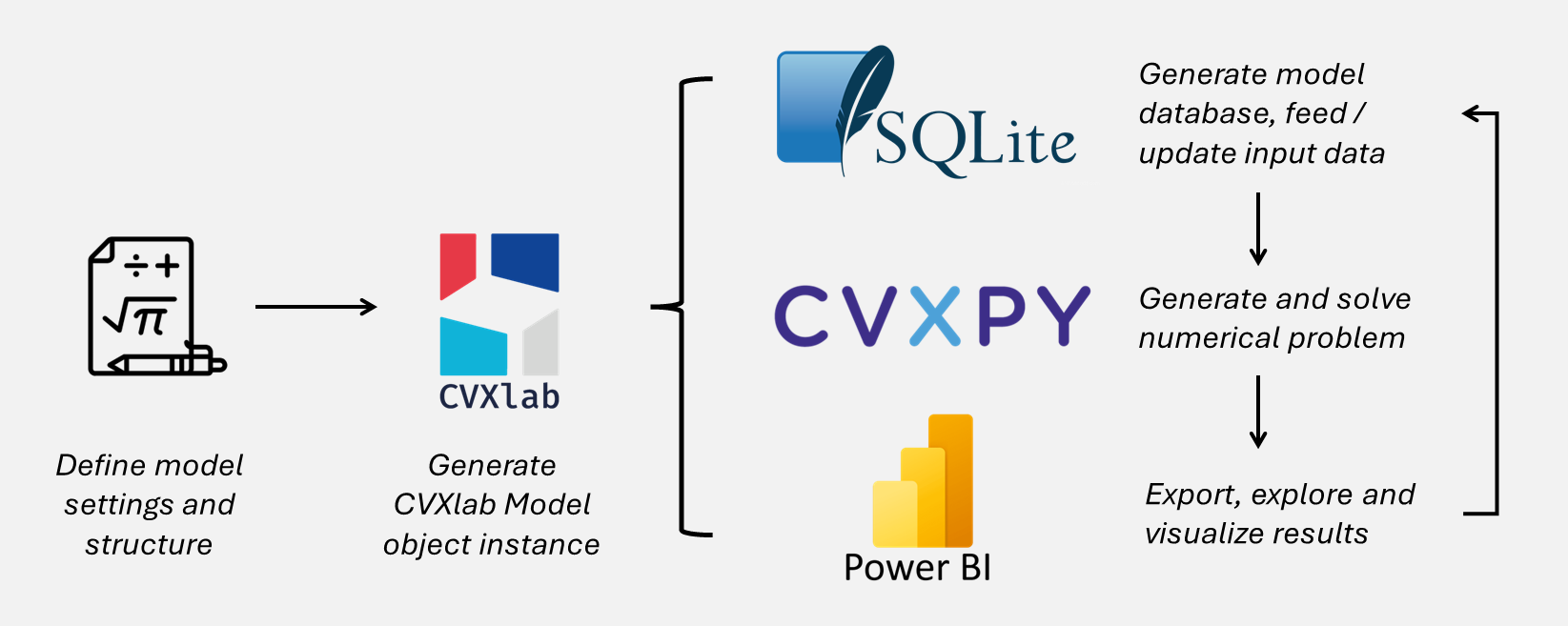
The figure below summarizes the package workflow. The detailed step-by-step explanation is in the User Guide, while runnable examples are collected in the Resources section.
Why CVXlab#
General-purpose model generator. Build a wide range of convex optimization models.
Almost no code required. Define model structure through YAML or Excel templates instead of hand-coding every object.
Centralized data management. Organize data in a SQLite database for traceable, reusable data handling.
Powerful engine embedded. Build convex and decomposed optimization workflows on top of CVXPY.
Start here#
Section |
What you will find |
|---|---|
How to install CVXlab and verify that the environment is ready. |
|
The full modeling workflow, from conceptual model definition to results export. |
|
Tutorials, models gallery, related publications and how to cite CVXlab. |
|
Technical reference for |
Note
CVXlab is developed by Matteo V. Rocco, Associate Professor at SESAM group, Department of Energy, Politecnico di Milano. The project is released under the Apache License 2.0.