
CVXlab documentation#
Warning
Beta Release Notice
CVXlab is currently in beta (1.0.1b1). The API is subject to change before the stable 1.0.0 release. Documentation is under active development. We welcome feedback and bug reports via GitHub Issues.
CVXlab - Open-source Python laboratory for convex algebraic modeling
Version: 1.0.1b1 Date: Dec 16, 2025
Useful Links: - PyPI Page - Source GitHub Repository - Issue Tracker
Package features#
CVXlab provides an efficient pipeline and a set of tools for defining, managing and solving numerical optimization problems. Its main features are summarized below:
General-purpose model generator: CVXlab enables to define a wide range of convex optimization problems, as well as nonlinear problems handled as sequence of convex problems (i.e. decomposed into coupled convex subproblems), solving them iteratively using a block Gauss-Seidel (alternating optimization) scheme. Numerical problems parametric analysis is also supported and made easy.
Almost no code required: mathematical problems settings based on Excel or yaml files, data collection based on Excel spreadsheets, and problem expressions defined literally as they are written on paper. Users can focus on the modeling of the problem rather than on programming issues. Very low coding skills are required, consisting in few lines of Python code to call the main package APIs.
Centralized data management based on SQLite databases: model data are arranged in a SQLite database (SQLite documentation), which allows to easily store, retrieve, and manage datasets for optimization problems. Database structure enables to easily visualize and analyze results through Business Intelligence tools (e.g. PowerBI).
Powerful engine embedded: numerical problems generated and solved based on CVXPY, a convex optimization modeling library for Python (see CVXPY documentation for a comprehensive description of the package capabilities).
CVXlab expand the capabilies of existing algebraic modeling frameworks, such as CVXPY, pyGAMS, JuMP or Pyomo, providing a full pipeline for the modeling process, from the problem definition to the solution and results analysis, with a special focus on centralized data management and user-friendliness. This makes CVXlab particularly suitable for practical applications in engineering and economics, where data are often scattered and not organized, and users may not have strong programming skills. Moreover, this framework standardizes and simplifies the modeling process, making it more reproducible, understandable and less error-prone, especially regarding data handling.
CVXlab in a nutshell#
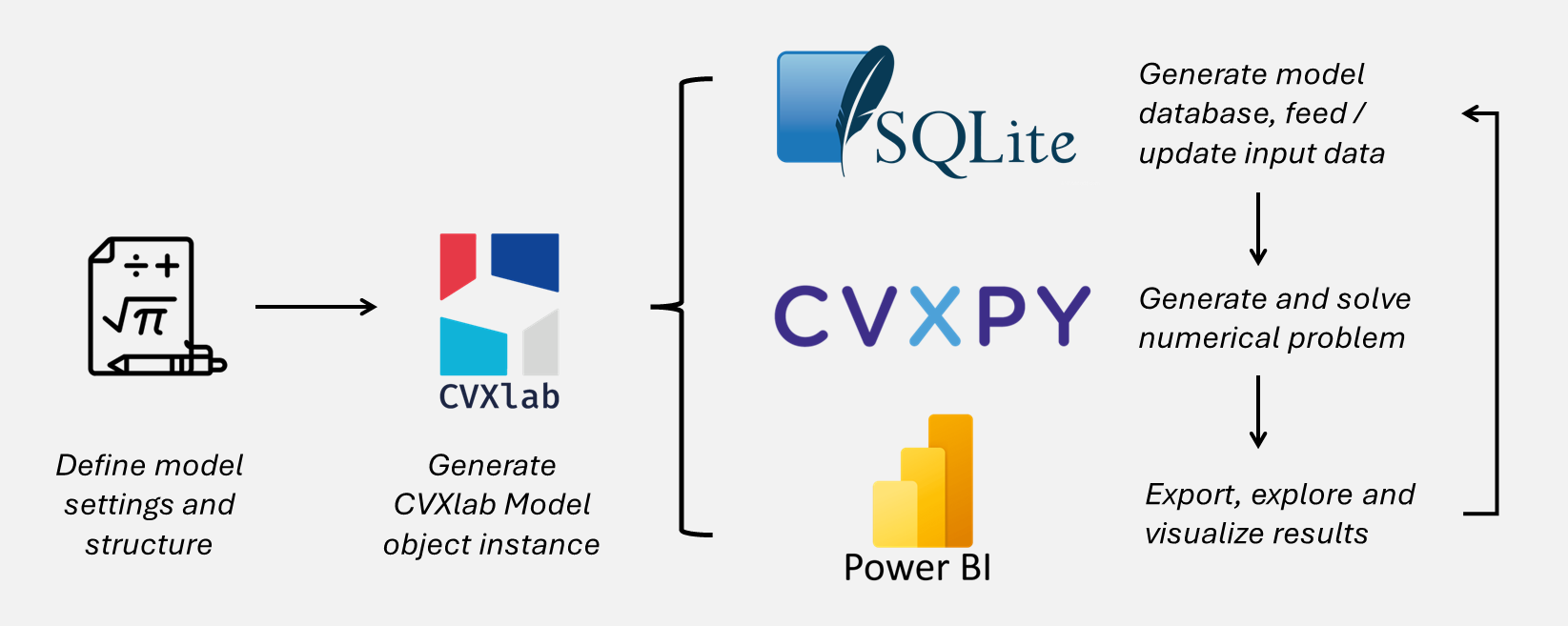
The figure below provides a synthetic and simplified overview of the CVXlab modeling process.
In generating and handling a CVXlab model, the user must follow the five fundamental activities summarized below:
The user defines the model settings and the related structure: model scope, structure of variables, and list of mathematical expressions, including equalities, inequalities and (eventually) objective function.
The user proceeds by generating a CVXlab Model object, consisting in a Python class instance embedding all the model settings and the methods useful to manage the model. At the same time, other items are generated, including the SQLite database file (to store all model data), and the Excel files serving as blank templates for collecting exogenous data from the user.
The user feeds input data to SQLite database through blank Excel template files. Specifically, user defines the data input required to characterize exogenous model variables.
The numerical problem is generated, exogenous data fetched from the database, and the problem is solved through CVXPY engine.
If problem is successfuly solved, results are finally exported to the database. Due to the structure of the relational database, it can be easily linked and inspected via Excel or SQL queries, or imported into Business Intelligence tools (such as PowerBI or Tableau) for more elaborated data visualization and analysis.
Documentation contents:
Note
CVXlab has conceived and developed by Matteo V. Rocco, Associate Professor at SESAM group, Department of Energy, Politecnico di Milano, Italy.
CVXlab is an open-source project based on the Apache License Version 2.0, (January 2004). Contributions and feedback are welcome!